Personalized Gifts
Photo Book vs. Photo Album: Which Makes a Better Gift?
Oct
A practical comparison of cost, flexibility, durability, appearance, preparation time, and recipient fit
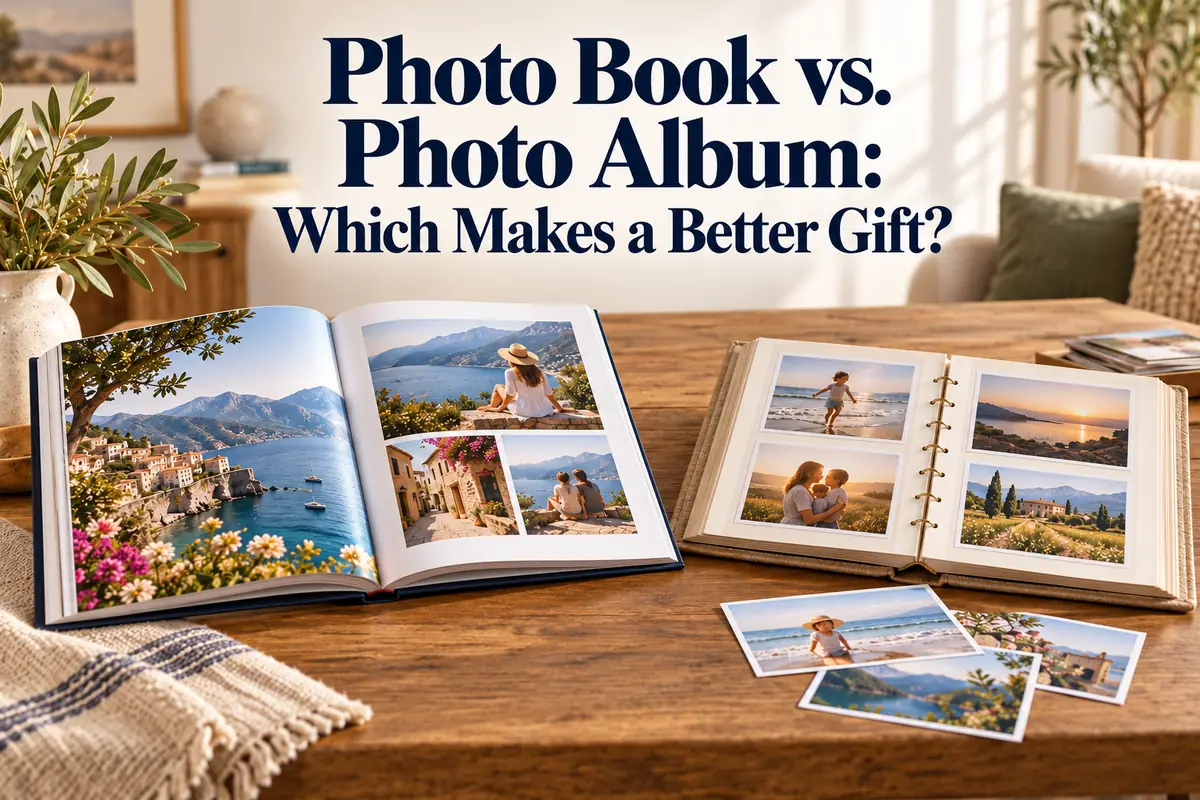
A photo book arrives as a finished story. A photo album leaves room for the story to continue.
1. The Short Answer
Choose a photo book when you want to give a polished, complete story that looks intentional the moment it is opened. Choose a photo album when the recipient will value adding, replacing, rearranging, or annotating photographs over time. Neither format is inherently more meaningful. The better gift is the one whose maintenance style matches the recipient.
For most milestone gifts built around one finished event, such as a wedding, graduation, retirement, or major trip, a well-edited photo book is the safer choice. For growing family histories, a baby’s first years, annual school photos, or a collection shared among relatives, a refillable archival album is usually more useful.
2. What Is the Real Difference?
A photo book is designed digitally and printed as a bound object. The photographs, captions, backgrounds, and page order become permanent when the order is placed. Its strength is editorial control: the giver can shape a beginning, middle, and end before the recipient sees it.
A photo album is a physical container for separate prints. Depending on the style, pictures slide into pockets, attach to photo-safe pages, or sit behind self-adhesive overlays. Its strength is physical flexibility: the owner can add another birthday, replace a poor print, include a note, or reorganize the sequence without remaking the whole gift.
3. Side-by-Side Comparison
| Criterion | Photo Book | Photo Album | Practical Edge |
| Typical initial cost | About $25–$60 for an everyday book; premium layflat formats can exceed $100 | About $20–$70 for the album, plus prints and supplies | Album can look cheaper at checkout, but prints and materials add up |
| Add more photos later | No. A new edition must be printed | Yes, if pages or pockets remain; refillable binders offer the most flexibility | Album |
| Durability | Bound pages stay aligned; thin pages and glued bindings vary by maker | Archival pockets protect prints; rings, sleeves, and adhesives are wear points | Depends on construction |
| Finished appearance | Consistent layouts, typography, color, and cover treatment | Can feel intimate and handmade; quality depends on print and assembly choices | Photo book for polish |
| Preparation time | Fast with auto-layout; slower when curating and revising many pages | Printing may be quick, but sorting, labeling, and mounting take hands-on time | Photo book for speed when the design is simple |
| Correction after completion | Limited or impossible without reordering | Easy to swap a print or change the order | Album |
| Clutter risk | Low: one self-contained object | Moderate: spare prints, refill pages, pens, and keepsakes need a home | Photo book |
| Best use | A complete event or tightly edited story | An ongoing collection or evolving family archive | Match the story |
4. Cost: Compare the Finished Gift, Not the Empty Product
The fair comparison is not a photo book versus an empty album. It is a finished photo book versus an album, printed photographs, optional refill pages, a photo-safe pen, and the time needed to assemble everything.
In current US pricing, basic photo books commonly begin in the mid-$20 range before shipping and upgrades. Premium paper, larger sizes, extra pages, and layflat binding can move the total well above $100. Traditional albums cover a broad range, but prints and archival supplies may add $10–$40 to the project. Promotional pricing can change the total substantially, so choose the format first and treat the sale as a bonus rather than the decision maker.
5. Ability to Add Photos
This is the clearest dividing line. A photo book freezes a moment. That permanence is valuable when the story already has a natural ending, such as a honeymoon, a first year in a home, or a memorial tribute. The recipient does not inherit a project; the gift is complete.
An album is better when the gift should remain open. A grandparent can add new school portraits, a couple can continue a home-renovation record, and a parent can preserve cards or ticket stubs beside photographs. If continued use matters, choose a refillable binder or a pocket format that uses a print size the recipient can easily order.
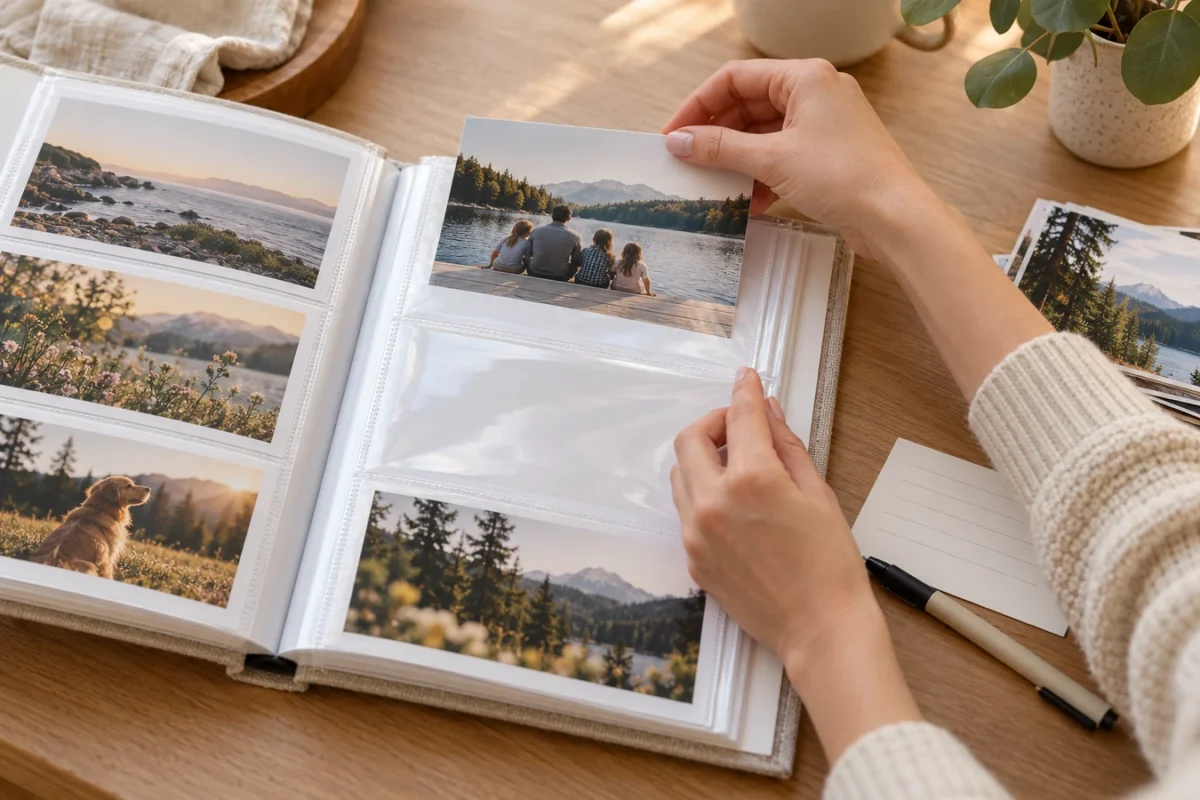
A refillable album is most useful when adding future photographs is part of the gift.
6. Durability and Long-Term Care
Durability depends more on materials and handling than on the label. For a photo book, examine binding, page thickness, surface finish, and whether the book opens comfortably without stressing the spine. Layflat pages work especially well for panoramic images and are less likely to hide faces in the center fold, but they add bulk and cost.
For an album, look for acid-free and lignin-free paper, photo-safe plastics, and replaceable components. Avoid low-quality adhesive pages when longevity matters because the adhesive can fail or make photographs difficult to remove. Pocket pages protect prints from fingerprints but may scratch or cloud with heavy use. A protective case or slipcover helps either format in a busy household.
7. Aesthetics and Emotional Effect
A photo book feels curated. Repeated fonts, controlled color, generous white space, and a deliberate sequence make ordinary images feel like a coherent story. This is particularly effective when the recipient prefers modern, uncluttered objects or may feel overwhelmed by an unfinished album.
A photo album feels tactile and participatory. Handwritten dates, small notes, imperfect snapshots, and physical keepsakes can make it warmer than a professionally printed book. That intimacy is an advantage only when the result feels intentional. An overfilled album with mismatched prints and unsafe tape can become difficult to browse and maintain.
8. Preparation Time and Deadline Risk
A photo book requires digital selection, layout, proofreading, production, and shipping. Auto-layout can create a draft quickly, but checking image crops, spelling, chronology, and resolution still matters. Order early enough to allow one production delay, especially before Christmas, Mother’s Day, Father’s Day, graduations, and anniversaries.
A photo album avoids commercial production time if you can buy it locally and print photographs the same day. The tradeoff is assembly time. Fifty prints may require several hours to sort, label, and place well. A last-minute album becomes thoughtful when it is intentionally partial: fill the opening pages, include labeled dividers, and add a note explaining that the recipient can continue it.
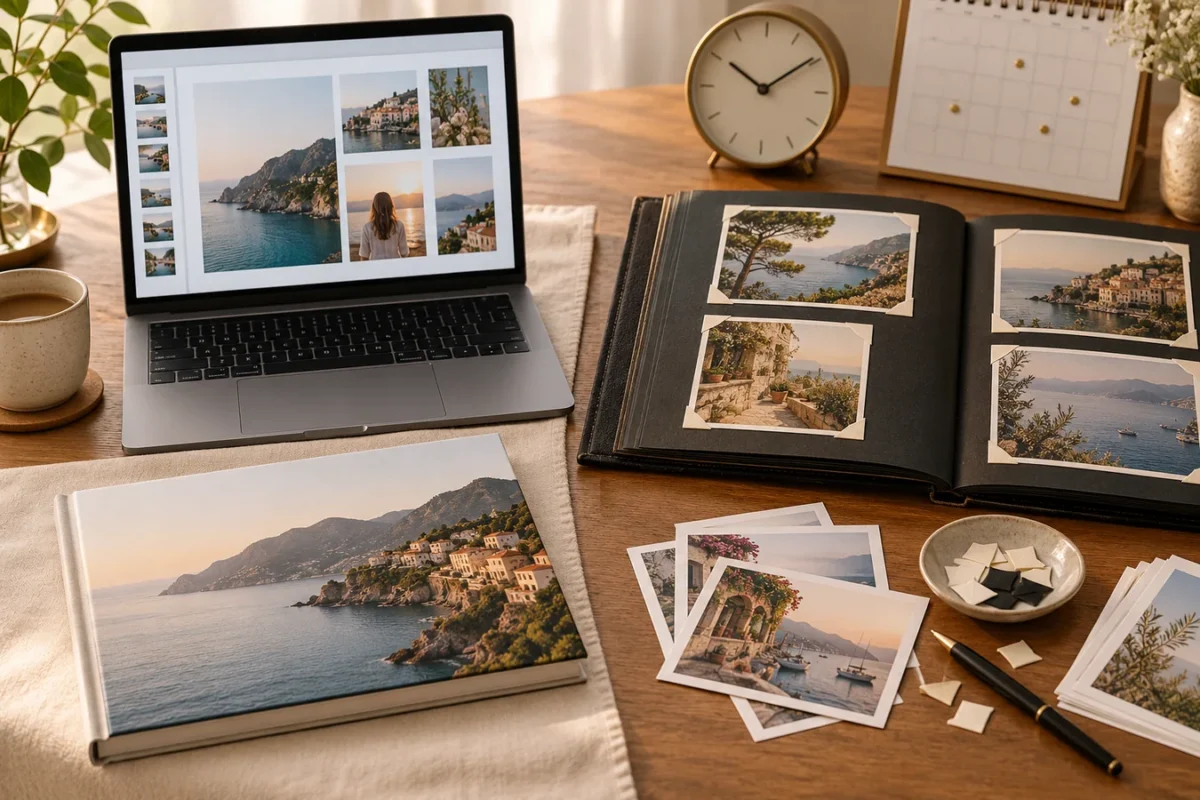
Digital design reduces hands-on assembly, while an album trades production time for flexible, physical work.
9. Decision Table: Which One Should You Choose?
| Situation | Choose | Why |
| One completed trip, wedding, or milestone | Photo book | The story already has a clear ending and benefits from a polished sequence |
| Baby, growing family, or annual school photos | Photo album | New images will arrive and need a natural place to go |
| Recipient dislikes projects or clutter | Photo book | It is complete, compact, and ready to enjoy |
| Recipient enjoys scrapbooking or handwriting notes | Photo album | The process is part of the pleasure |
| You have strong digital photos but no physical prints | Photo book | One workflow handles design and printing |
| You have inherited prints or mixed-size originals | Photo album | Physical formats and keepsakes are easier to preserve together |
| The gift must be ready in two days | Photo album | Local album and same-day prints reduce shipping risk |
| You want identical gifts for several relatives | Photo book | Duplicate copies remain consistent and are easy to reorder |
| Recipient may want privacy control | Photo album | They can remove or rearrange sensitive pictures |
| A panoramic image is the centerpiece | Layflat photo book | A seamless spread gives the image more visual impact |
10. Budget Examples That Lead to Different Answers
Under $35
Choose a compact softcover photo book when you have 20–35 strong digital images from one event and want a complete gift. Choose a simple pocket album when you already own printed photographs or need the recipient to add more later. At this budget, avoid spending on decorative extras before protecting image quality and sturdy construction.
$35 to $75
This range supports a hardcover photo book with a restrained page count or a good archival album filled with 40–80 prints. The photo book offers stronger visual consistency. The album offers more future capacity. For a parent or grandparent who receives new family photos regularly, the album usually delivers more long-term value.
$75 to $150
A larger hardcover or entry-level layflat photo book works well for a wedding, major anniversary, or once-in-a-lifetime trip. An album at the same budget can include archival pages, a protective case, high-quality prints, and room to grow. Choose the premium book for a finished statement; choose the album when stewardship of the family archive is part of the recipient’s role.
Above $150
Spend this much only when materials, scale, and emotional significance justify it. A premium layflat book can become an heirloom centerpiece. A high-end refillable album can preserve original prints and documents across generations. More pages are not automatically better. Editing, labeling, and preservation choices create more value than sheer volume.
11. Match the Format to the Recipient
For a minimalist: choose a compact photo book with a calm cover and a tightly edited image count.
For a memory keeper: choose a refillable archival album with a familiar print size and a photo-safe pen.
For an older relative: prioritize readable captions, manageable weight, and layouts that do not require tiny images.
For a busy parent: choose a book if you can finish the story for them; choose an album only if adding photos is already a habit.
For a couple: a photo book suits one shared chapter, while an album suits a tradition that will continue.
For someone grieving: use a photo book for a carefully bounded tribute; use an album when relatives will contribute photographs over time.
12. Photo Quality Requirements
Photo books are less forgiving of low-resolution files because images may be enlarged across a full page or spread. Use original files when possible, review every crop, and avoid screenshots downloaded from social media. A sharp image with natural color usually looks better than a heavily filtered file.
Albums are more tolerant because a modest-resolution image can be printed at 4 × 6 inches rather than enlarged. They also allow you to exclude a weak print without redesigning the rest of the gift. For both formats, preserve the original aspect ratio when cropping faces, hands, pets, or meaningful background details.
13. Common Mistakes to Avoid
Choosing a refillable album for someone who does not enjoy maintaining physical collections.
Ordering a photo book so late that expedited production becomes the largest cost.
Using every available image instead of selecting photographs that move the story forward.
Failing to proofread names, dates, locations, and captions before a book becomes permanent.
Using unsafe tape, glue, paper, or plastic in an album intended for long-term preservation.
Buying an unusual album size that makes future prints or refill pages difficult to obtain.
Assuming premium materials can compensate for weak editing or repetitive photographs.
14. Final Recommendation
If you are still undecided, ask one question: should this gift feel finished, or should it invite the recipient to continue it? Choose a photo book for finished. Choose a photo album for continuing.
For most gift buyers working with digital images and a defined occasion, the photo book is the more reliable choice because it arrives polished, compact, and complete. The photo album becomes the better gift when future participation is genuinely useful rather than merely possible. That distinction protects the recipient from receiving an attractive object that quietly becomes another unfinished task.
15. Frequently Asked Questions
Is a photo book more expensive than a photo album?
Not always. Compare the completed cost. An album also needs prints and may require archival pages, pens, mounts, or refills. Basic versions of either can fit a modest budget, while premium versions can exceed $100.
Which lasts longer?
Either can last for decades when made with good materials and stored away from moisture, direct sunlight, and extreme heat. Construction quality and handling matter more than the format name.
Can I add pages to a photo book?
Usually no. Some services let you add pages before ordering, but the bound book is fixed after printing. A new edition must be created for additional photographs.
Is a scrapbook the same as a photo album?
A scrapbook is a type of album designed for creative layouts, notes, and keepsakes. It demands more time and usually creates a more handmade result than a pocket album.
Which format is better for old printed photographs?
A photo album is easier when you want to preserve originals without scanning them. If you want copies for several relatives, scan the photographs and create duplicate photo books while keeping the originals stored safely.
Which is better as a last-minute gift?
A locally purchased album with same-day prints is safer when the deadline is immediate. A photo book is practical only when production and shipping time are certain.
Should I leave blank pages in an album gift?
Yes, when growth is the point. Fill enough pages to establish the story, then make the remaining space feel intentional with dividers, dates, or a short note about what can be added next.
Editorial Pricing Note
Budget examples are planning ranges, not fixed quotations. Prices vary by size, page count, binding, paper, promotions, shipping, and tax. Pricing context checked October 2026 against current US photo-book listings and pricing guidance from Shutterfly and Artifact Uprising.
