
Personalized Gifts
Personalized Photo Gifts That Are Actually Useful: What to Choose and Why

Oct
A practical comparison of photo gifts by use frequency, image requirements, personalization, clutter, and recipient fit
A useful photo gift begins with a useful object. This guide compares ten common formats and shows when personalization improves the product and when it simply adds clutter.
1. Quick Answer: Choose the Object Before the Photo
The most useful personalized photo gift starts with an object the recipient already uses. The photograph should make that object more personal, not turn it into something less practical. A calendar is useful to someone who plans on paper. A phone case works only when the model, protection level, and design match the recipient. A mug is useful only when it is comfortable to hold and safe for the way it will be washed.
Before selecting images, ask three questions: Does the recipient already use this type of product? Will the photo survive regular handling and cleaning? Does the design suit where the item will be used? If any answer is uncertain, personalization cannot rescue the choice.
For most recipients, the safest high-use options are a desk or wall calendar, an insulated tumbler, a phone case chosen with exact specifications, or a compact photo book designed to be revisited rather than displayed.
2. What Makes a Photo Gift Genuinely Useful
Usefulness has four parts. First, the object must perform its basic job well. A leaking tumbler remains a bad gift even with a perfect photograph. Second, the recipient must have a natural place for it in an existing routine. Third, the design must withstand washing, sunlight, friction, bending, or frequent touch. Fourth, the photograph must remain readable at the product’s actual size.
Personalization should not increase maintenance. Products that require hand-washing, special storage, delicate handling, or permanent display create friction. A recipient may appreciate the idea but avoid using the item because preserving the image becomes work.
Clutter risk matters too. Replacing an object the recipient already needs creates little clutter. Adding another mug, blanket, notebook, or keychain to an existing collection creates more. The goal is to personalize a useful category, not to manufacture an obligation to keep something.
3. How to Read the Comparison
The comparison uses frequency of use as the starting point, but frequency alone does not determine the winner. Photo requirements describe how sharp, bright, and well-composed the original image should be. Personalization level reflects how prominently the photograph shapes the item. Clutter risk estimates whether the product is likely to become an extra object rather than a replacement. Recipient fit identifies the situations in which the choice works best.
High personalization is not automatically better. A subtle luggage tag can feel more appropriate than a full-coverage blanket. Likewise, a low-clutter item can still fail if the recipient dislikes visible family photographs in public or at work.
4. The Ten Product Types Compared
| Product | Use frequency | Photo quality needed | Personalization | Clutter risk | Best recipient fit |
| Photo calendar | Daily or weekly | Medium; several sharp images | Medium | Low; expires | Families, grandparents, planners |
| Phone case | Daily | High; one clear image with crop space | High | Low if replacing | People who use decorative cases |
| Insulated tumbler | Daily | Medium; simple image or small collage | Medium | Low to medium | Commuters, parents, teachers |
| Photo mug | Daily for the right person | Medium; bright close subject | Medium | Medium; mugs accumulate | Coffee or tea drinkers |
| Personalized tote | Weekly | Medium; simple bold image | Medium to high | Medium | Shoppers, students, library users |
| Photo blanket | Seasonal to frequent | High; large simple image | High | High | Homebodies, dorms, grandparents |
| Compact photo book | Occasional, revisited | Medium to high; edited set | High | Low to medium | Trips, family chapters, milestones |
| Photo notebook | Daily to occasional | Medium; strong cover image | Low to medium | Low if recipient writes | Students, planners, professionals |
| Luggage tag | Travel days | Low to medium; simple image | Low to medium | Very low | Travelers and students |
| Photo keychain | Daily if keys are carried | Low; one close image | Medium | Low | Drivers, homeowners, grandparents |
Use frequency assumes the product already fits the recipient’s routine. A high rating does not compensate for poor product quality or incorrect specifications.
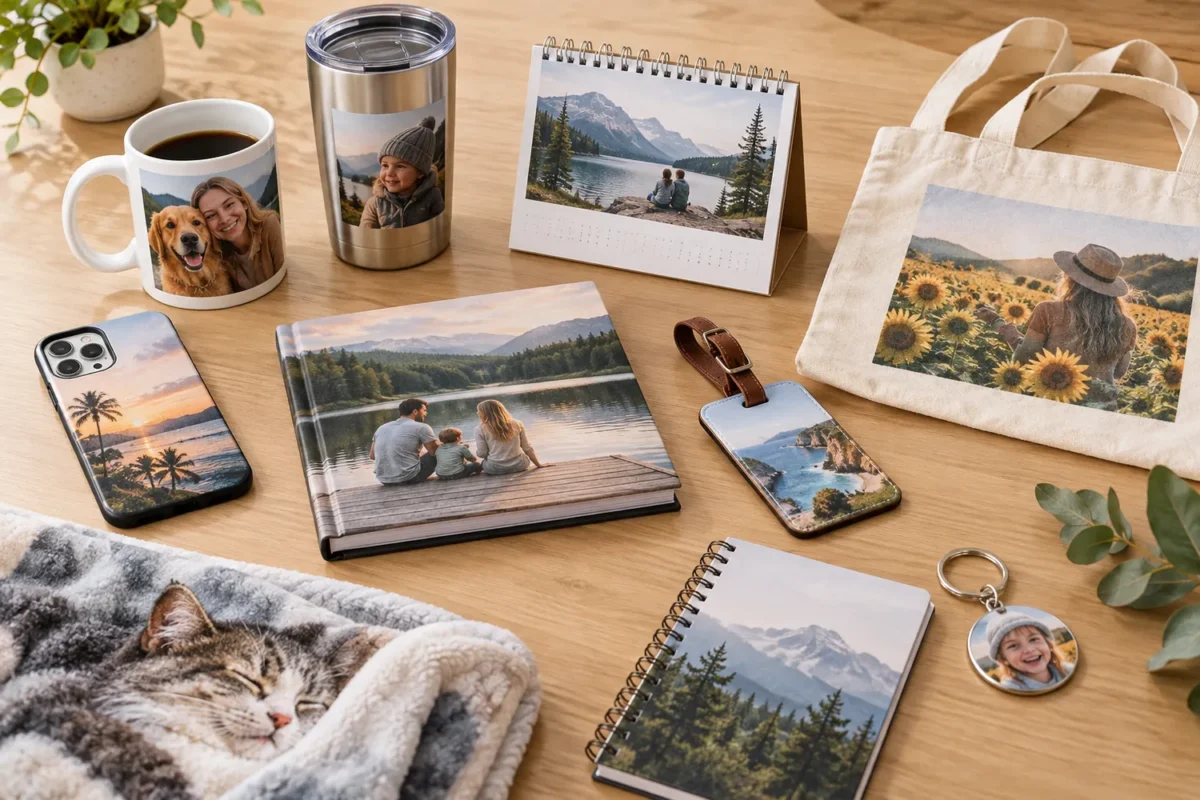
The same photograph can feel useful or burdensome depending on the object, design, and recipient.
5. Best for Daily Use: Phone Cases, Tumblers, and Calendars
A phone case can be the most frequently used photo gift in the group, but it has the narrowest technical margin for error. Confirm the exact phone model, preferred case thickness, wireless-charging needs, grip, camera clearance, and protection level. Choose one strong image with clear space around faces so the camera cutout does not remove an important detail. This is a good fit for a recipient who already uses decorative cases and does not mind carrying a personal image publicly.
An insulated tumbler has broader compatibility. The product quality matters more than the printable area: the lid should seal, the base should fit common cup holders, and the finish should tolerate washing. A small photo panel or restrained collage tends to age better than an edge-to-edge print. It works well for commuters, parents, teachers, and anyone who carries a drink daily.
A calendar combines repeated use with low long-term clutter because it expires naturally. It can hold twelve or more photographs without forcing them into one crowded design. The image standard can vary by month, although the cover and largest pages still need sharp files. Calendars suit grandparents, families, home-office users, and anyone who plans visually.
6. Useful at Home: Mugs, Blankets, and Photo Books
A mug is familiar, affordable, and easy to personalize, but many households already own too many. It works best as a replacement for a worn favorite or when the recipient has a specific coffee or tea routine. Check capacity, handle comfort, microwave safety, and dishwasher guidance. Use one or two bright images with faces large enough to remain visible on the curved surface.
A photo blanket can be used regularly in a cold home, dorm, reading chair, or family room. It also carries the highest clutter and taste risk. Fabric weight, softness, edge finishing, and print method matter. Large simple photographs reproduce better than many small faces. Choose it only when the recipient uses throws and has space for another one.
A compact photo book occupies the middle ground between utility and memory. It is not used every day, but it can be revisited without needing wall space. A short, edited book with a clear purpose is more usable than a large archive. Build it around one trip, year, relationship, recipe collection, or family chapter, and leave visual breathing room.
7. Useful on the Go: Totes, Luggage Tags, and Keychains
A personalized tote is useful for groceries, work materials, library visits, or travel when the bag itself is strong. Inspect handle length, fabric weight, seams, interior structure, and washability. A single photo panel or small repeated motif is easier to carry than an oversized face. It suits people who already use reusable bags and are comfortable with visible personalization.
A luggage tag creates little clutter and requires only a modest image. It is best for frequent travelers, students, and families who need to identify similar bags. The photograph should be simple and recognizable from a distance. Privacy information belongs on the protected side, not in the photo design.
A keychain is compact and inexpensive, but it competes with existing keys, car fobs, and digital entry systems. Choose it when the recipient already carries keys and prefers small tokens. Rounded edges, a secure ring, and a scratch-resistant image cover matter more than decorative extras.
8. Useful for Work or Study: Personalized Notebooks

Useful personalization belongs inside an existing routine rather than creating a new display obligation.
A notebook can be useful for a student, planner, journal keeper, meeting note-taker, or creative professional. It becomes clutter when the recipient works entirely digitally or already has unused notebooks.
Prioritize paper quality, binding, page format, and the ability to lie flat. A photograph on the cover should support rather than overwhelm the design. Landscapes, pets, architecture, and small family moments often feel more appropriate in public settings than a large formal portrait.
Because a notebook is consumable, personalization has a natural end point. That can make it easier to use than a permanent decorative object.
9. Match Image Quality to the Printing Surface
Start with the original file whenever possible. Screenshots, images downloaded from social media, and photos forwarded repeatedly through messaging apps may look acceptable on a phone but print poorly. The larger the product and the closer it will be viewed, the more resolution matters.
Sharp focus is only one requirement. Brightness, contrast, cropping space, skin tone, and background simplicity affect the final result. Dark images often print darker. Faces near an edge may be cut by templates, seams, handles, lids, camera openings, or binding.
For a small object, use one clear subject. For a calendar or photo book, vary close-ups and wider scenes. For textiles, avoid tiny details and thin lines. Always preview every side of the product at full size and check the safe-print area before ordering.
10. Control the Level of Personalization
Personalization can be private, subtle, visible, or immersive. A hidden photo inside a notebook cover is private. A small image on a luggage tag is subtle. A phone case is visible. A full photo blanket is immersive. Choose the level based on the recipient’s comfort, not the emotional importance of the photograph.
Public-facing items require extra care. Coworkers, teenagers, new partners, and private people may prefer pets, landscapes, hobbies, or shared places instead of family portraits. Grandparents and close relatives may welcome faces more openly, but even then, good design matters.
When uncertain, reduce the photo size and improve the object quality. Restraint often makes a personalized gift more usable.
11. A Five Step Selection Method
First, name an object the recipient already uses. Second, decide whether this gift replaces, upgrades, or adds to what they own. Replacement and upgrade choices usually create less clutter. Third, choose the personalization level that fits where the item will appear: private home, workplace, school, travel, or public errands.
Fourth, select the image after reviewing the product template. Match orientation, crop, and resolution to the printable area. Fifth, confirm product specifications, care instructions, delivery time, and return policy before ordering. Customized products often cannot be returned unless defective.
If the choice still feels uncertain, use a calendar or compact photo book. Both accommodate multiple images, avoid technical compatibility problems, and can be tailored to the recipient’s preferred level of visibility.
12. Frequently Asked Questions
What is the most useful personalized photo gift? A product the recipient already uses. Calendars, tumblers, and correctly specified phone cases often have the highest routine use.
Which photo gift creates the least clutter? A calendar expires naturally, while a luggage tag or keychain occupies little space. A notebook is consumable when the recipient actually writes.
How many photos should a personalized gift include? One strong image is usually best for small objects. Calendars and photo books can support a carefully edited sequence.
Are photo blankets practical? They can be, but only for recipients who use throws and have space. They carry higher taste and clutter risk than smaller items.
Can a social media photo be printed? Sometimes, but the downloaded version may be compressed. Request the original file whenever possible and check the print preview for warnings.
Should every photo gift show people? No. Pets, landscapes, homes, handwritten recipes, artwork, and meaningful places may be easier to use in public.
What should I avoid? Poor-quality base products, inaccurate technical specifications, crowded collages, embarrassing images, oversized personalization, and items the recipient already owns in excess.
13. Choose Usefulness First and Memory Second
A photo gift succeeds when the recipient can use it without treating it as fragile, ceremonial, or obligatory. The photograph should deepen the value of an already suitable object.
Choose the routine first, then the product, then the image. That order prevents a meaningful photograph from being placed on something unnecessary. The result is quieter than a display piece, but it may become part of hundreds of ordinary days. That repeated use is what makes the gift genuinely personal.
